Flutter vs React Native: Which Should You Choose in 2026?
Choosing the right mobile development framework is one of the most important decisions you'll make when building an application. It affects everything from development speed and performance to maintenance costs and future scalability.
Two frameworks dominate cross-platform mobile development in 2026: Flutter and React Native.
Both allow developers to build Android and iOS applications from a single codebase, saving time and money compared to maintaining separate native apps. However, they differ in architecture, programming languages, rendering approaches, and long-term advantages.
So which one should you choose?
This guide compares Flutter and React Native across the factors that matter most, helping you select the best framework for your project.
What Is Flutter?
Flutter is Google's open-source UI toolkit that enables developers to build high-performance applications for Android, iOS, Web, Windows, macOS, and Linux from a single codebase.
Flutter uses the Dart programming language and its own rendering engine, giving developers complete control over the user interface.
Many global companies use Flutter because of its speed, consistency, and ability to create beautiful, responsive applications.
What Is React Native?
React Native is Meta's open-source framework for building mobile applications using JavaScript and React.
Instead of rendering everything itself, React Native communicates with native platform components, allowing developers to reuse much of their web development knowledge while creating mobile apps.
It remains a popular choice, especially for teams already experienced with React.
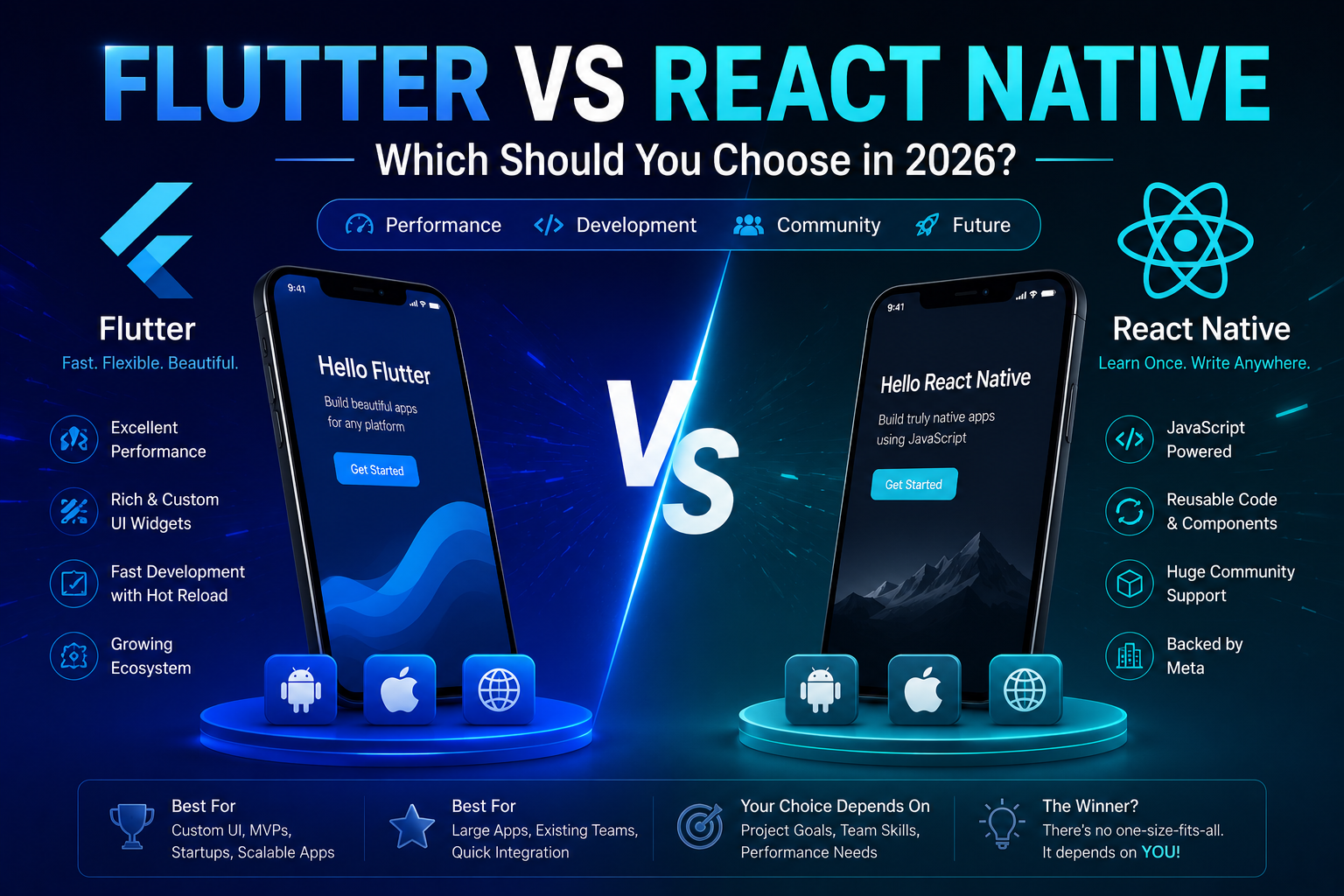
Flutter vs React Native at a Glance
| Feature | Flutter | React Native |
|---|---|---|
| Developer | Meta | |
| Programming Language | Dart | JavaScript |
| Performance | ⭐⭐⭐⭐⭐ | ⭐⭐⭐⭐ |
| UI Consistency | Excellent | Very Good |
| Learning Curve | Moderate | Easier for JavaScript Developers |
| Community | Large | Very Large |
| Development Speed | Excellent | Excellent |
| Hot Reload | Yes | Yes |
| Web Support | Excellent | Good |
| Desktop Support | Excellent | Limited |
1. Performance
Performance is one of the biggest reasons businesses choose Flutter.
Flutter
Flutter compiles directly into native machine code and uses its own rendering engine, resulting in:
- Faster animations
- Smooth scrolling
- Consistent performance
- Better graphics rendering
This makes Flutter particularly well-suited for applications with complex user interfaces or animations.
React Native
React Native delivers strong performance for many business applications, but some intensive tasks rely on a bridge between JavaScript and native components. While improvements continue to reduce overhead, highly demanding interfaces may require additional optimization.
Winner: Flutter
2. User Interface
A polished user interface improves user satisfaction and brand perception.
Flutter
Flutter includes a rich collection of customizable widgets that allow developers to create visually consistent applications across Android and iOS.
Designs closely match the original mockups without relying heavily on platform-specific components.
React Native
React Native uses native UI components, giving applications a more platform-specific look and feel. However, achieving identical designs across devices may require additional customization.
Winner: Flutter
3. Development Speed
Both frameworks are designed to accelerate development.
They support:
- Hot Reload
- Code reuse
- Third-party packages
- Rapid prototyping
For teams familiar with JavaScript, React Native offers a gentle learning curve. Flutter requires learning Dart but provides a highly productive development experience once developers are comfortable with the language.
Winner: Tie
4. Programming Language
Flutter
Uses Dart, a modern language optimized for UI development.
Advantages include:
- Fast compilation
- Strong typing
- Excellent tooling
- Easy maintenance
React Native
Uses JavaScript, one of the world's most widely used programming languages.
Advantages include:
- Huge developer community
- Abundant learning resources
- Easy hiring
- Extensive ecosystem
Winner: React Native
5. Community and Ecosystem
A strong community means more libraries, tutorials, plugins, and support.
Flutter
Flutter's community continues to grow rapidly, with thousands of packages available through pub.dev.
React Native
React Native has been around longer and benefits from a mature JavaScript ecosystem, offering a wide range of libraries and integrations.
Winner: React Native (slightly)
6. Cost of Development
Both Flutter and React Native reduce costs by allowing developers to maintain a single codebase for Android and iOS.
However, Flutter often requires less platform-specific customization, which can simplify maintenance over time.
Estimated project costs are generally similar for both frameworks, with differences depending more on project scope than on the framework itself.
Winner: Tie
7. Scalability
Business applications often evolve with new features, users, and integrations.
Flutter's architecture and rendering engine make it well-suited for building applications that scale while maintaining consistent performance across platforms.
React Native also scales effectively but may require additional optimization for highly complex applications.
Winner: Flutter
8. AI Integration
Artificial Intelligence is increasingly becoming a core feature of modern applications.
Both frameworks can integrate with AI services such as:
- OpenAI
- Google Gemini
- Anthropic Claude
- Azure AI
- AWS AI Services
The choice of framework has little impact on AI capabilities, as most integrations rely on APIs.
Winner: Tie
Flutter vs React Native: Which One Is Better?
Choose Flutter if you need:
- Beautiful custom interfaces
- High-performance animations
- Enterprise applications
- Long-term scalability
- Cross-platform consistency
- Web and desktop support
Choose React Native if you:
- Already have a React team
- Need JavaScript expertise
- Want to leverage existing React code
- Prefer native platform components
- Have a mature JavaScript development workflow
Common Mistakes When Choosing a Framework
Avoid making your decision based solely on popularity.
Instead, consider:
- Your project's complexity
- Performance requirements
- Team expertise
- Long-term maintenance
- Budget
- Future expansion
- Integration needs
The best framework is the one that aligns with your business goals and technical requirements.
Frequently Asked Questions
Is Flutter faster than React Native?
For graphics-intensive applications and complex user interfaces, Flutter generally delivers smoother performance because it compiles directly to native machine code and uses its own rendering engine.
Can Flutter build iOS and Android apps?
Yes. Flutter enables developers to build Android and iOS applications from a single codebase while also supporting web and desktop platforms.
Is React Native easier to learn?
If you already know JavaScript and React, React Native is typically easier to learn because it builds on familiar concepts and tools.
Which framework is better for startups?
Both frameworks are excellent choices for startups. Flutter is often preferred when design consistency and performance are priorities, while React Native is attractive for teams with existing JavaScript expertise.
Final Verdict
Both Flutter and React Native are outstanding frameworks for cross-platform mobile development in 2026. The right choice depends on your team's skills, project requirements, and long-term vision.
If you're building a visually rich application with demanding performance requirements and plans to expand across multiple platforms, Flutter offers a compelling combination of speed, consistency, and scalability.
If your organization already has a strong React ecosystem and wants to maximize JavaScript expertise, React Native remains a powerful and flexible option.
The most important decision isn't simply choosing a framework—it's selecting the one that best supports your business objectives and future growth.
Build Your Next Mobile App with AiWeapX
Whether you choose Flutter or React Native, AiWeapX develops secure, scalable, and high-performance mobile applications tailored to your business needs.
Our mobile development services include:
- Flutter Development
- React Native Development
- Android Applications
- iOS Applications
- UI/UX Design
- AI Integration
- API Development
- Cloud Integration
- App Store & Google Play Deployment
- Ongoing Maintenance and Support
Ready to turn your app idea into reality? Contact AiWeapX today for a free consultation and let our team help you choose the right technology for your next mobile application.